
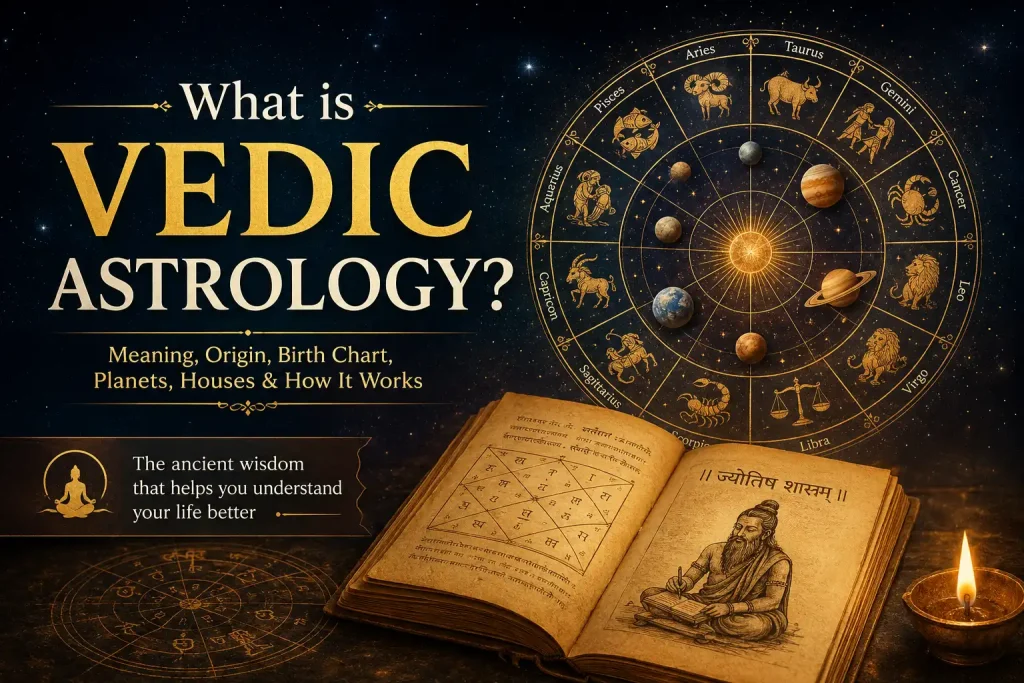
For thousands of years, people have looked up at the night sky and wondered if the movement of the planets has any connection with life on Earth. In India, this curiosity gave birth to one of the world’s oldest astrological traditions Vedic Astrology, also known as Jyotish Shastra.
The word Jyotish comes from the Sanskrit word Jyoti, meaning “Light” Rather than predicting every event with certainty, Vedic Astrology aims to shine a light on a person’s strengths, challenges, opportunities, and life patterns. It is considered a tool for self-awareness, helping individuals make informed decisions instead of walking through life blindly.
Whether you have heard about Kundli matching, planetary periods, or the influence of Saturn, all of these are part of the rich system of Vedic Astrology. But what exactly is it, and why do millions of people still rely on it today?
The Origins of Vedic Astrology
Vedic Astrology has its roots in the ancient Vedas, the oldest sacred texts of India, dating back several thousand years. Over centuries, scholars and sages refined the system by observing planetary movements and their relationship with human experiences.
Unlike modern Western Astrology, which mainly uses the tropical zodiac, Vedic Astrology follows the sidereal zodiac. This system is based on the actual positions of the constellations in the sky, making it unique in its calculations.
The goal of Vedic Astrology has never been entertainment. Traditionally, it was used to choose auspicious dates, understand life events, guide kings in decision-making, and help individuals live in harmony with cosmic cycles.
What Is a Birth Chart?
The foundation of Vedic Astrology is the birth chart, often called a Kundli or Janma Kundali.
A birth chart is created using three important details:
- Date of birth
- Exact time of birth
- Place of birth
Using these details, an astrologer calculates the positions of the planets at the exact moment of birth. These planetary positions are then plotted across twelve houses, creating a unique cosmic blueprint for that individual.
Just as no two fingerprints are identical, no two birth charts are exactly the same.
The Nine Planets in Vedic Astrology
Vedic Astrology works with nine planetary influences, known as the Navagrahas.
These include:
- Sun (Surya)
- Moon (Chandra)
- Mars (Mangal)
- Mercury (Budh)
- Jupiter (Guru)
- Venus (Shukra)
- Saturn (Shani)
- Rahu (North Lunar Node)
- Ketu (South Lunar Node)
Each planet represents different areas of life.
For example:
- The Sun represents confidence, authority, and self-expression.
- The Moon governs emotions, mind, and mental well-being.
- Jupiter signifies wisdom, knowledge, growth, and prosperity.
- Venus relates to love, relationships, beauty, and comforts.
- Saturn teaches discipline, patience, responsibility, and long-term growth.
Rahu and Ketu are not physical planets but mathematical points where the Moon’s orbit intersects the Earth’s path around the Sun. Despite not being visible planets, they play an important role in Vedic Astrology and are often linked to karmic lessons and significant life changes.
Understanding the Twelve Houses
The birth chart is divided into twelve houses, each representing a different aspect of life.
Some examples include:
- First House: Personality and physical appearance
- Second House: Wealth and family
- Third House: Communication and courage
- Fourth House: Home and mother
- Fifth House: Education, creativity, and children
- Sixth House: Health and competition
- Seventh House: Marriage and partnerships
- Eighth House: Transformation and hidden matters
- Ninth House: Fortune, spirituality, and higher learning
- Tenth House: Career and reputation
- Eleventh House: Income and achievements
- Twelfth House: Spirituality, foreign travel, and expenses
The meaning of a house changes depending on which planets occupy it and which zodiac sign rules it.
The Importance of Zodiac Signs
Vedic Astrology uses twelve zodiac signs, known as Rashis.
These are:
- Aries
- Taurus
- Gemini
- Cancer
- Leo
- Virgo
- Libra
- Scorpio
- Sagittarius
- Capricorn
- Aquarius
- Pisces
Each sign has unique qualities that influence how planetary energies are expressed.
For instance, Mars behaves differently in Aries than it does in Cancer, just as Jupiter expresses its qualities differently in Sagittarius than in Capricorn.
Dashas: The Timing System
One of the most distinctive features of Vedic Astrology is its predictive timing system called Dashas.
Rather than making broad predictions, Dashas identify periods when certain planets become more active in a person’s life.
For example, someone entering a Jupiter Mahadasha may experience opportunities related to education, career growth, marriage, or financial improvement, depending on the rest of the birth chart.
Likewise, a Saturn Mahadasha may bring greater responsibilities, discipline, and long-term rewards after sustained effort.
This timing system is one of the reasons many people consider Vedic Astrology especially detailed and practical.
Can Vedic Astrology Predict the Future?
This is one of the most common questions people ask.
Vedic Astrology does not claim that every event is fixed or unavoidable. Instead, it identifies probabilities, tendencies, and periods when certain experiences are more likely.
Think of it like a weather forecast.
If heavy rain is expected tomorrow, you may choose to carry an umbrella. The forecast doesn’t force the rain to affect you in a particular way it simply helps you prepare.
Similarly, astrology offers guidance so that people can make wiser choices and navigate life with greater awareness.
Common Reasons People Consult Vedic Astrology
People seek guidance from Vedic Astrology for many different reasons, including:
- Career planning
- Business decisions
- Marriage compatibility
- Financial growth
- Education
- Health concerns
- Family matters
- Foreign travel
- Personal development
- Spiritual guidance
Many also consult astrologers during periods of uncertainty, hoping to better understand the opportunities and challenges ahead.
Is Vedic Astrology Scientific?
The relationship between astrology and science has been debated for many years.
Modern science generally does not recognize astrology as a scientifically proven method for predicting life events. However, Vedic Astrology continues to be practiced and studied as a traditional system of knowledge with deep cultural and historical significance.
For millions of people, its value lies not only in prediction but also in self-reflection, personal guidance, and understanding recurring life patterns.
Like many ancient disciplines, its usefulness often depends on individual beliefs, experience, and the skill of the practitioner interpreting the chart.
Final Thoughts
Vedic Astrology is much more than daily horoscope columns or generic zodiac predictions. It is a detailed system that combines planetary positions, zodiac signs, houses, planetary periods, and numerous interpretive principles to build a personalized picture of an individual’s life.
A well-prepared birth chart can highlight natural talents, reveal potential challenges, and provide insight into important areas such as career, relationships, finances, and personal growth. Rather than viewing life as predetermined, many practitioners see astrology as a map one that helps people understand the road ahead while remembering that the choices they make still matter.
Whether you approach Vedic Astrology from a spiritual perspective, cultural tradition, or simple curiosity, learning about your birth chart can be an interesting journey of self-discovery. It offers a different way of looking at life’s experiences and encourages greater awareness of both opportunities and obstacles.