
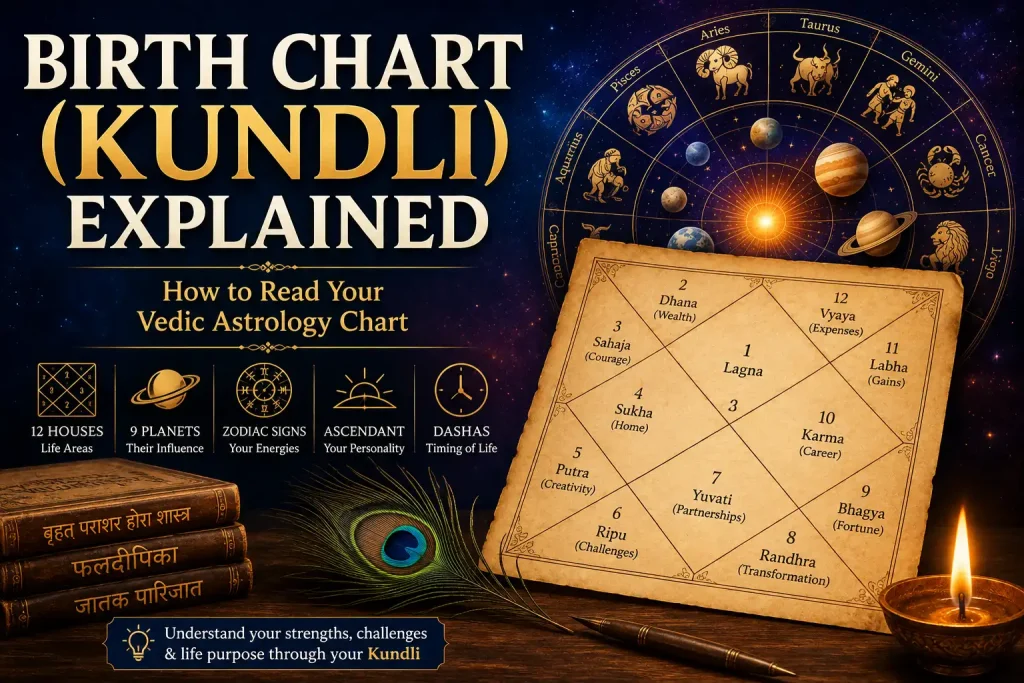
Have you ever wondered why two people born under the same zodiac sign can have completely different personalities, careers, and life experiences? One person may become a successful entrepreneur, while another chooses a life dedicated to art or teaching. This is one of the reasons Vedic Astrology places so much importance on the birth chart, also known as a Kundli.
Unlike newspaper horoscopes that are based only on your zodiac sign, a Kundli is unique to you. It is prepared using your exact date, time, and place of birth, creating a detailed map of the sky at the moment you were born. Every planet’s position is carefully calculated, making your chart as unique as your fingerprint.
Understanding a birth chart may seem complicated at first, but once you know the basics, it becomes much easier to see why it is considered the foundation of Vedic Astrology.
What Is a Kundli?
A Kundli, or birth chart, is a diagram that shows the positions of the planets and zodiac signs at the exact moment of your birth.
Astrologers believe these planetary positions reflect your natural strengths, challenges, personality traits, relationships, career potential, finances, health, and important life cycles. Rather than determining your future with certainty, a Kundli serves as a guide that helps you better understand yourself and the opportunities that may arise throughout your life.
Every interpretation begins with this chart, making it the single most important document in Vedic Astrology.
What Information Is Needed to Create a Birth Chart?
Only three details are required:
- Date of birth
- Exact time of birth
- Place of birth
The birth time is especially important because even a difference of a few minutes can change the Ascendant (Lagna), house placements, and certain predictive techniques. If the birth time is unknown or inaccurate, some parts of the chart may be less precise.
This is why astrologers always recommend providing the most accurate birth information possible.
Why Every Birth Chart Is Unique
Even twins born just minutes apart can have small differences in their charts due to changes in planetary positions and house divisions. As time passes, the Ascendant moves continuously, which can alter the overall structure of the chart.
Because of this, Vedic Astrology does not rely solely on your Sun sign or Moon sign. Instead, it studies the complete planetary arrangement to build a personalized picture of your life.
The Twelve Houses
A Kundli is divided into twelve houses, each representing a different area of life.
The First House reflects your personality, appearance, confidence, and overall approach to life.
The Second House relates to wealth, family, savings, speech, and values.
The Third House represents communication, courage, siblings, skills, and short journeys.
The Fourth House governs home, mother, property, education, and emotional security.
The Fifth House is associated with intelligence, creativity, children, education, romance, and self-expression.
The Sixth House deals with health, competition, debts, obstacles, and daily work.
The Seventh House represents marriage, partnerships, business relationships, and public dealings.
The Eighth House is connected with transformation, inheritance, hidden matters, research, and sudden events.
The Ninth House governs luck, higher education, spirituality, long-distance travel, and teachers.
The Tenth House is considered the house of career, profession, reputation, authority, and achievements.
The Eleventh House represents income, friendships, ambitions, gains, and social networks.
The Twelfth House relates to foreign travel, spiritual growth, expenses, isolation, and liberation.
No house is completely good or bad. Their influence depends on the planets occupying them and the overall balance of the chart.
The Nine Planets
Vedic Astrology studies nine planetary influences called the Navagrahas.
The Sun represents leadership, confidence, authority, and personal identity.
The Moon governs emotions, mental well-being, imagination, and daily habits.
Mars signifies courage, determination, energy, competition, and action.
Mercury represents communication, learning, business, intelligence, and analytical thinking.
Jupiter is associated with wisdom, knowledge, prosperity, teaching, ethics, and expansion.
Venus governs relationships, beauty, creativity, luxury, comfort, and artistic talents.
Saturn represents discipline, patience, responsibility, hard work, and long-term success.
Rahu symbolizes ambition, innovation, foreign connections, technology, and worldly desires.
Ketu is connected with spirituality, intuition, detachment, inner wisdom, and past-life influences.
Each planet behaves differently depending on the sign and house it occupies.
What Is the Ascendant (Lagna)?
One of the most important parts of a Kundli is the Ascendant, also called the Lagna.
The Ascendant is the zodiac sign rising on the eastern horizon at the exact moment of birth. It determines the layout of the entire birth chart and influences your personality, physical characteristics, and how you approach life.
Many experienced astrologers consider the Ascendant even more important than the Sun sign because it forms the starting point for interpreting the entire chart.
Planetary Combinations Matter
A common misconception is that one planet alone decides your destiny.
In reality, astrologers study combinations.
For example, Jupiter in the Tenth House may indicate career growth, but the final interpretation depends on its strength, aspects, conjunctions, house lordship, planetary periods, and many other factors.
This is why professional chart reading involves studying the chart as a complete system rather than focusing on a single placement.
Dashas: Understanding Timing
A birth chart shows your overall life potential, but timing comes from planetary periods known as Dashas.
These periods indicate when certain planets become more influential.
For example, one person may have strong career combinations in their chart but experience significant success only during a favorable planetary period.
Dashas help explain why opportunities appear at specific stages of life rather than all at once.
Can You Read Your Own Kundli?
Learning the basics is possible, and many people enjoy understanding the meanings of houses, planets, and zodiac signs.
However, interpreting an entire birth chart accurately requires much more than simply reading where each planet is placed. Professional astrologers consider planetary strengths, aspects, yogas, divisional charts, planetary periods, and many other advanced techniques before reaching meaningful conclusions.
This deeper analysis is what turns a collection of planetary positions into practical guidance.
Common Misconceptions
Many people believe that one “bad” planet can ruin an entire life or that one “good” planet guarantees lifelong success.
Vedic Astrology does not work this way.
Every chart contains strengths and challenges. Even planets traditionally considered difficult can produce positive results under the right conditions, while naturally beneficial planets may become less helpful depending on their placement.
A balanced interpretation always considers the complete chart instead of isolated placements.
Final Thoughts
Your birth chart is much more than a collection of planets and symbols. It is a personalized map created from the exact time and place of your birth, offering insights into your personality, relationships, career, finances, and life’s major themes.
While a Kundli cannot eliminate uncertainty or make decisions for you, it can provide valuable perspective. It highlights natural talents, reveals areas that may require greater effort, and helps you understand the timing of important opportunities and challenges.
Whether you are simply curious about Vedic Astrology or looking for deeper guidance, understanding your birth chart is the first step toward discovering what makes your journey unique. The more accurately your chart is prepared and interpreted, the more meaningful the insights are likely to be.